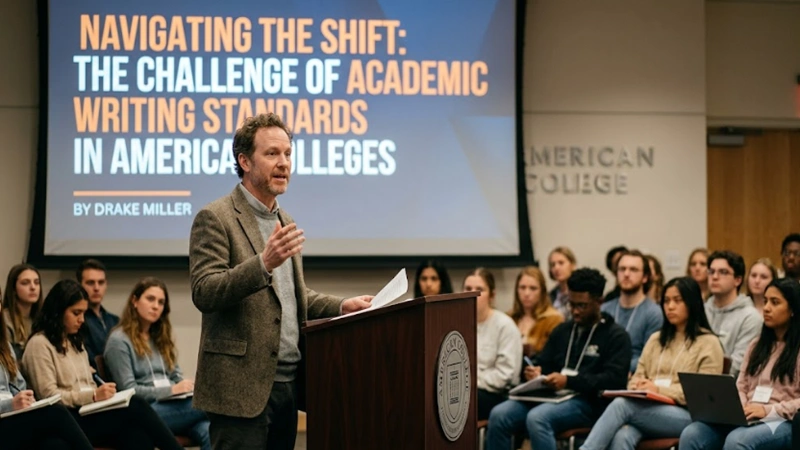
The transition from high school to American higher education is often framed as a rite of passage, marked by newfound independence and intellectual exploration. However, for many students, the most significant hurdle isn’t the social adjustment or the rigor of the curriculum—it is the sudden, steep escalation in academic writing standards.
In the United States, academic writing is not merely a tool for communication; it is the primary currency of evaluation. Whether you are a freshman at a community college or a graduate student at an Ivy League institution, the ability to synthesize complex ideas into a coherent, evidence-based argument is the ultimate litmus test of academic success. Yet, as the landscape of education evolves in 2026, many students find themselves struggling to bridge the gap between “good enough” and “academic excellence,” often seeking online assignment help to master these high-level expectations.
The Core Conflict: Synthesis vs. Summary
In many high school environments, writing assignments often lean toward summary and comprehension. Students are asked to demonstrate that they have read a text or understood a concept. In the American collegiate system, however, the “C-level” paper is a summary, while the “A-level” paper is a synthesis.
Synthesis requires the writer to draw connections between disparate sources, identifying patterns, contradictions, and gaps in existing literature. This transition requires a fundamental shift in cognitive approach. Instead of being a passive recipient of information, the student must become an active participant in an academic conversation. This is the difference between reporting on what happened and arguing why it matters in a broader socio-economic or scientific context.
The Nuances of the American “Style”
While academic writing globally prioritizes clarity and evidence, American colleges emphasize specific stylistic and structural norms that can be jarring for international students or those from varied educational backgrounds.
1. The Power of the Thesis Statement
In the U.S., a paper is only as strong as its thesis. Unlike some international styles that allow for a narrative journey where the conclusion is revealed at the end, American academic writing is largely “deductive.” The reader expects to know the central argument by the end of the first page. This “roadmap” style demands a level of precision that many students find restrictive, yet it is essential for navigating the high-volume reading loads of American professors.
2. Clarity over Complexity
There is a common misconception among students that “academic” means “dense.” In reality, American professors increasingly value clarity and concision. The challenge lies in explaining sophisticated concepts without hiding behind jargon. For those in technical fields, finding help in programming assignments can be particularly useful to learn how to document code and logic with this same level of professional clarity.
3. Rigid Adherence to Citation Styles
Whether it’s APA, MLA, Chicago, or Turabian, the American obsession with citation is not just about avoiding plagiarism. It is about “mapping” the intellectual history of an idea. For students, mastering the minutiae of a 7th edition manual while simultaneously trying to argue a point about organic chemistry is a massive cognitive load.
The “Hidden Curriculum” and the Skills Gap
One of the greatest challenges in maintaining writing standards is the “hidden curriculum”—the set of skills that professors assume students already have, but which are rarely taught explicitly.
- Information Literacy: The ability to distinguish between a peer-reviewed journal and a well-designed blog post.
- Structural Logic: Knowing how to transition between historical context and data analysis without losing the reader.
- Voice and Agency: Finding the balance between citing experts and asserting one’s own scholarly voice.
When students lack these foundational elements, the quality of their work suffers, leading to “grade shock”—the phenomenon where a straight-A high school student receives their first C- or D on a college essay.
The Role of Digital Literacy and AI in 2026
As we move through the 2026 academic cycle, the challenge of writing standards has been further complicated by the ubiquity of Large Language Models (LLMs) and Agentic AI. While these tools offer incredible potential for research, they have also blurred the lines of authorship.
The modern challenge for American colleges is teaching students how to maintain “Agentic Literacy.” This involves using AI as a research coordinator or a “rubber duck” for logic checking, rather than a ghostwriter. Maintaining academic integrity while utilizing modern tools is perhaps the most significant update to the traditional writing rubric. Students must learn to document their AI-assisted workflows just as rigorously as they document their physical sources.
Strategies for Mastery: 2026-2027 Success Framework
To meet and exceed American academic writing standards, students must move beyond the five-paragraph essay format. Here are the pillars of high-level collegiate writing for the upcoming academic year:
Active Recall and Pre-Writing
Success in writing starts before the first word is typed. Using active recall to test your understanding of the source material ensures that your argument is built on a solid foundation. When you truly understand the material, your writing becomes more fluid and authoritative.
The “Deep Work” Approach
Writing is a high-cognition task. It cannot be done effectively in ten-minute bursts between social media checks. Adopting “Deep Work” principles—undistracted, intense focus for 90-minute blocks—is often the only way to produce the level of synthesis required by top-tier American universities.
Utilizing Professional Scaffolding
The best writers do not work in a vacuum. Utilizing writing centers and expert academic writing support allows students to see their work through the eyes of an evaluator. This external perspective is crucial for identifying “logical leaps” that the author might be too close to see. Academic support services act as a bridge, providing the model structures necessary to understand complex APA or MLA standards.
Why Standards Matter: The Professional Leap
It is easy for a student to view a 15-page research paper as a hoop to jump through. However, the standards enforced in American colleges are designed to prepare students for the global professional world. The ability to communicate complex data to stakeholders, write persuasive white papers, and document processes with precision is a high-value skill set.
Whether you are aiming for a career in law, medicine, engineering, or digital marketing, the “writing” is often the most visible part of your expertise. A poorly written report can undermine years of brilliant research. In the 2026 job market, where AI-generated content is everywhere, the ability to produce high-quality, human-led synthesis is a premium competitive advantage
Frequently Asked Questions
Q.1 Is it considered plagiarism to use AI for brainstorming in 2026?
The definition of academic integrity is evolving. In 2026, many US institutions distinguish between “AI-generated content” and “AI-assisted research.” Using AI to organize your thoughts or check your logic is often acceptable, but submitting AI-written text as your own is a violation of most Honor Codes. Maintaining “Agentic Literacy” means you stay in control of the creative and analytical process.
Q.2 What is the most common citation mistake in American colleges?
The most frequent error isn’t just the formatting (commas vs. periods), but the failure to cite the origin of an idea. Many students believe they only need to cite direct quotes. In the U.S. system, you must cite paraphrased ideas as well. Mastering the nuances of APA 7th Edition or MLA 9th Edition is a critical skill that impacts your overall GPA.
Q.3 How can I improve my academic writing quickly?
The fastest way to improve is through iterative feedback. Instead of turning in a first draft, use peer review groups or professional academic consulting services. Seeing a model of a correctly structured essay helps you internalize the expectations of your professors much faster than reading a textbook alone.
Q.4 Why is the “Thesis Statement” so important in US writing?
In the American “deductive” style, the thesis acts as a contract between the writer and the reader. It tells the professor exactly what you intend to prove. Without a clear, debatable thesis statement, your writing will likely be seen as “aimless,” which is a common critique of freshman-level papers.
Conclusion: The Path Forward
The challenge of academic writing standards in American colleges is not going away. If anything, as information becomes more accessible via AI, the value of the human ability to curate, analyze, and argue that information becomes higher.
For students in high school looking toward college, or current undergraduates struggling with their workload, the message is clear: writing is a muscle. It requires regular exercise, the right coaching, and an understanding of the “rules of the game.” By embracing the rigor of synthesis, mastering the technicalities of citation, and utilizing both human and technological resources wisely, students can turn the challenge of academic writing into their greatest competitive advantage. See more